If you're running Google Ads, ROAS is the number that tells you whether your campaigns are actually working. But what counts as a good ROAS — and does a higher number always mean better results?
The short answer: a 4x ROAS is considered the baseline benchmark for Google Ads in 2026, but depending on your margins, a 4x ROAS could be highly profitable or quietly losing you money. This guide explains why — and gives you the benchmarks you need to set the right target for your business.
What Is ROAS?
ROAS stands for Return on Ad Spend. It measures how much revenue you generate for every dollar spent on advertising.
Formula:
Example: You spend $2,000 on Google Ads and generate $8,000 in revenue. Your ROAS is 4x (or 400%).
ROAS is different from ROI. ROAS only looks at revenue vs. ad spend. ROI looks at profit vs. all costs — including cost of goods sold, agency fees, and overhead. Always use ROAS for campaign-level decisions and ROI for overall business decisions.
What Is a Good ROAS for Google Ads in 2026?
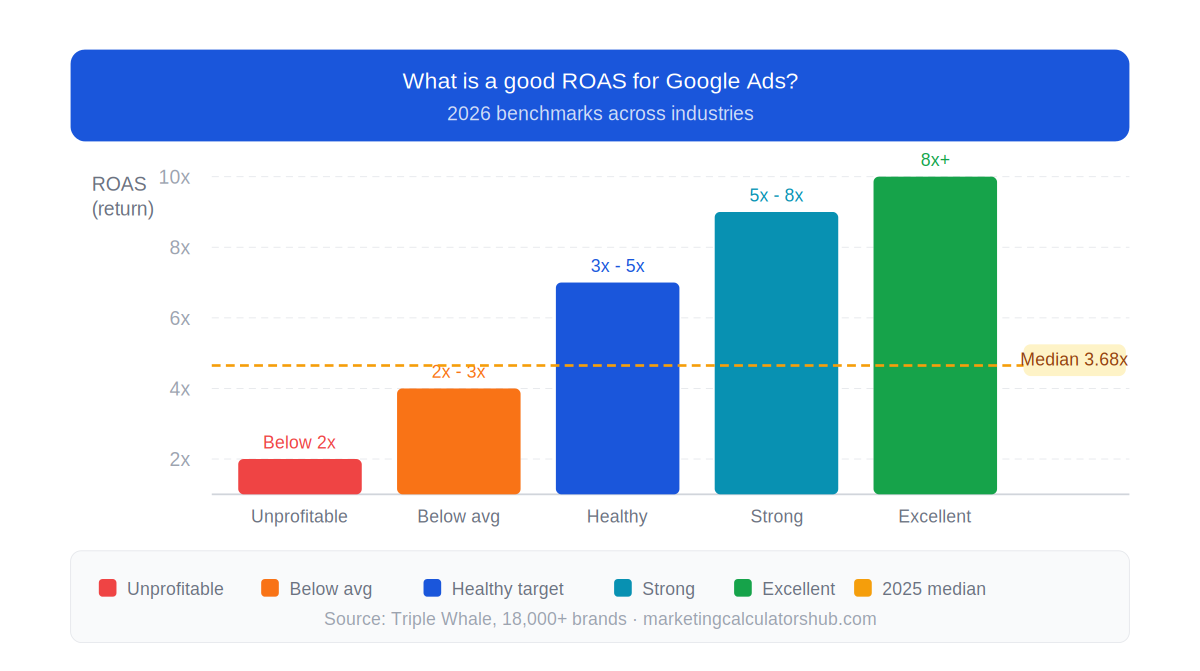
Based on data from over 18,000 brands tracked through 2025, here are the current Google Ads ROAS benchmarks:
| ROAS Level | What It Means |
|---|---|
| Below 2x | ⚠️ Likely unprofitable — pause and optimise immediately |
| 2x – 3x | 🟡 Below average — needs improvement |
| 3x – 5x | ✅ Healthy — industry benchmark for most businesses |
| 5x – 8x | 🚀 Strong — above average performance |
| 8x+ | 🏆 Excellent — top-tier campaign performance |
The median Google Ads ROAS in 2025 was 3.68x across all industries. Most well-managed campaigns target 4x as a minimum threshold.
ROAS Benchmarks by Industry (2026)
Industry matters enormously. A 3x ROAS is perfectly healthy for a low-margin retailer but dangerously low for a SaaS company. Here's how different industries compare:
| Industry | Avg ROAS | Target ROAS |
|---|---|---|
| eCommerce (general) | 3x – 4x | 4x – 6x |
| Fashion & Apparel | 3x – 5x | 5x+ |
| B2B / Lead Generation | 2x – 4x | 3x – 5x (measure pipeline value) |
| SaaS / Software | 3x – 6x | 5x+ (measured on LTV) |
| Health & Wellness | 2.1x – 3.5x | 3x – 4x |
| Travel & Hospitality | 4x – 6x | 6x+ |
| Home & Garden | 3x – 5x | 4x – 6x |
Why Your Profit Margin Determines Your Minimum ROAS
This is the part most guides skip — and it's the most important. Your break-even ROAS is determined entirely by your gross margin:
Here's what that means in practice:
| Gross Margin | Break-Even ROAS | What This Means |
|---|---|---|
| 20% | 5x | You need 5x ROAS just to break even |
| 30% | 3.3x | 3.3x covers your ad spend and COGS |
| 50% | 2x | Anything above 2x is profitable |
| 70% | 1.43x | High-margin SaaS — even 2x ROAS is very profitable |
So a 4x ROAS with a 20% margin is actually losing money — you need 5x just to break even. The same 4x ROAS with a 50% margin is comfortably profitable. Always calculate your break-even ROAS before setting campaign targets.
5 Ways to Improve Your Google Ads ROAS
1. Use Target ROAS bidding correctly. Google's Target ROAS smart bidding works best when your campaign has at least 30–50 conversions per month. Below that threshold, manual CPC or Target CPA will outperform it. Set your target 10–20% above your current ROAS to give the algorithm room to optimise without cutting spend too aggressively.
2. Tighten your keyword match types. Broad match keywords in 2026 cast a very wide net — sometimes too wide. Audit your Search Terms report weekly and add negative keywords for irrelevant queries burning budget. Moving high-spend broad match terms to phrase or exact match often improves ROAS by 20–40%.
3. Fix your landing page. A rising CTR with falling conversion rate — a pattern seen across 13 of 14 industries in 2025 — signals a landing page problem, not an ad problem. Test headline clarity, CTA placement, page speed (target under 2.5 seconds), and mobile experience. A 1% conversion rate improvement can double your ROAS without changing a single ad.
4. Segment campaigns by margin. Don't run high-margin and low-margin products in the same campaign with the same ROAS target. A $200 product with 60% margin needs a very different ROAS target than a $30 product with 15% margin. Separate them and set individual targets based on break-even ROAS per product category.
5. Use audience layering. Overlay remarketing audiences, customer match lists, and in-market segments on your Search campaigns. Bid higher for users who've visited your site or are in your CRM — they convert at 2–5x the rate of cold traffic and dramatically improve overall ROAS.
Calculate Your ROAS Right Now
Use our free Google Ads ROI Calculator to calculate your current ROAS, break-even point, and net profit from your campaigns. Enter your ad spend, revenue, and gross margin to get your real profitability picture in seconds.
You can also use our Marketing ROI Calculator to compare Google Ads performance against other channels and decide where to allocate budget for maximum return.
Frequently Asked Questions
What is the average ROAS for Google Ads?
The median Google Ads ROAS across all industries in 2025 was 3.68x, down 10% from the prior year as costs rose and conversion rates dipped. Most well-managed campaigns target 4x as a minimum. High-performing campaigns in competitive niches like travel and SaaS achieve 6x–8x.
Is a 2x ROAS good for Google Ads?
It depends on your margin. For a business with 60%+ gross margin (like SaaS), a 2x ROAS is profitable. For a retailer with 20–30% margins, a 2x ROAS likely means you're losing money once COGS and overhead are factored in. Calculate your break-even ROAS first: Break-Even ROAS = 1 ÷ Gross Margin %.
What ROAS should I target for eCommerce?
Most eCommerce businesses target 4x–6x ROAS on Google Ads. The exact target depends on your gross margin — a 30% margin business needs at least 3.3x to break even, so 5x+ is a healthy target. High-volume, low-margin categories like electronics or grocery may have lower targets but rely on volume.
Why is my Google Ads ROAS dropping?
The most common causes are: rising CPCs (up industry-wide in 2025), declining landing page conversion rates, increased competition in your keywords, audience fatigue (same ads shown too often), or seasonal demand shifts. Audit your Search Terms report, test new ad copy, and check your landing page speed and mobile experience first.