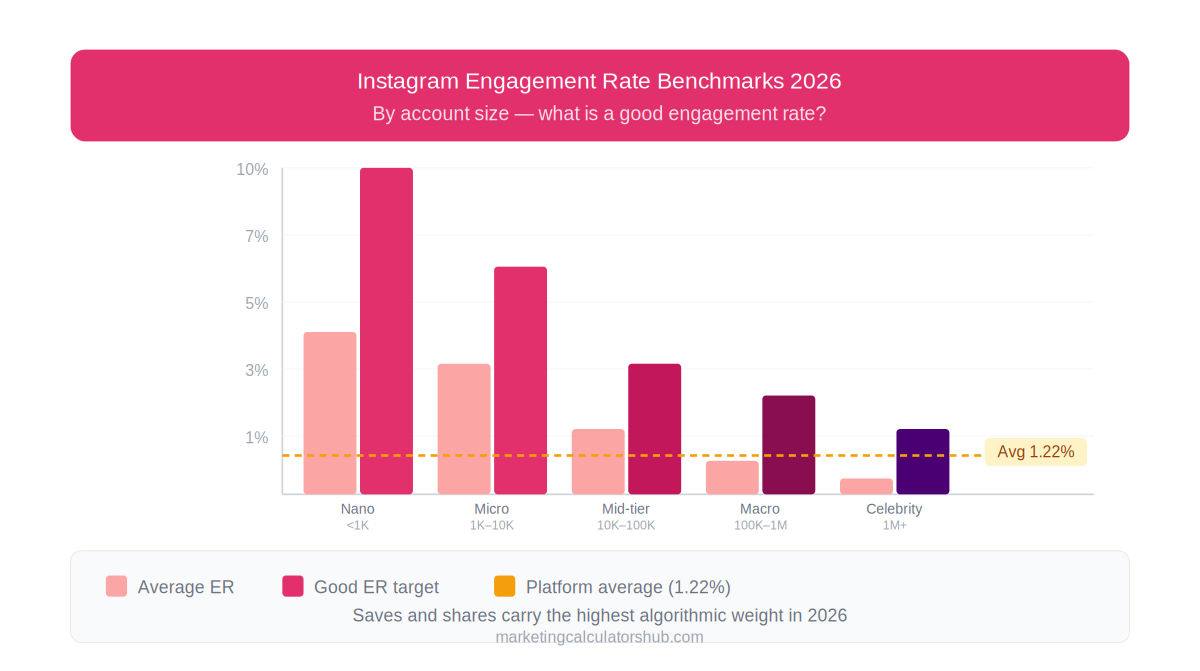
Instagram engagement rate is the metric that separates accounts with real influence from those with inflated follower counts. In 2026, brands increasingly allocate influencer budgets based on engagement rate rather than followers alone — meaning your engagement rate directly affects your earning potential and organic reach.
But what counts as a good engagement rate? The answer depends on your follower count, industry, and content type. This guide gives you the 2026 benchmarks you need, the formula to calculate it, and proven strategies to improve it.
What Is Instagram Engagement Rate?
Instagram engagement rate measures how actively your audience interacts with your content relative to your follower count or reach. It captures likes, comments, saves, and shares — the four signals Instagram's algorithm uses to determine how widely to distribute your posts.
Unlike follower count (which is a vanity metric anyone can inflate), engagement rate reveals the quality of your audience. A fitness creator with 20,000 followers and a 6% engagement rate will consistently outperform a lifestyle influencer with 200,000 followers and a 0.4% rate — in both algorithmic reach and brand deal value.
How to Calculate Instagram Engagement Rate
There are three formulas used across the industry. Use the one that matches your reporting goal:
Formula 1: Engagement Rate by Followers (Most Common)
Example: 15,000 followers, 220 likes, 18 comments, 45 saves, 12 shares across one post.
Formula 2: Engagement Rate by Reach (ERR)
More meaningful than follower-based ER because it measures engagement among people who actually saw the post. A good ERR on Instagram is 1–3%.
Formula 3: Average Engagement Rate (Multiple Posts)
Always calculate your engagement rate across 10–30 posts for an accurate baseline. Single-post ER is too volatile to be meaningful.
Use our free Instagram Engagement Rate Calculator to calculate all three formulas instantly.
Instagram Engagement Rate Benchmarks by Follower Count (2026)
| Account Size | Poor | Average | Good | Excellent |
|---|---|---|---|---|
| Nano (<1K) | <3% | 3–5% | 5–10% | 10%+ |
| Micro (1K–10K) | <2% | 2–4% | 4–7% | 7%+ |
| Mid-tier (10K–100K) | <1% | 1–2% | 2–4% | 4%+ |
| Macro (100K–1M) | <0.5% | 0.5–1.5% | 1.5–3% | 3%+ |
| Celebrity (1M+) | <0.2% | 0.2–0.8% | 0.8–2% | 2%+ |
The platform-wide average across all Instagram accounts is approximately 1.22%. However, comparing your rate to this overall average is misleading — a 50K account with 1.5% is performing well, while a 1K account with 1.5% needs significant improvement.
Instagram Engagement Rate Benchmarks by Industry (2026)
| Industry | Average ER | Top 25% |
|---|---|---|
| Non-Profit | 1.87% | 3.8%+ |
| Fitness & Health | 1.85% | 3.5%+ |
| Entertainment | 1.73% | 3.2%+ |
| Travel | 1.41% | 2.8%+ |
| Food & Beverage | 1.16% | 2.5%+ |
| Fashion & Beauty | 0.96% | 2.2%+ |
| Technology | 0.54% | 1.2%+ |
| Business / B2B | 0.35% | 0.8%+ |
What Counts as an Engagement on Instagram in 2026?
Instagram's algorithm weights different engagement types differently. From highest to lowest weight:
- Shares — Highest signal. Sharing to Stories or DMs tells Instagram your content is worth spreading. Prioritise shareable content above all else.
- Saves — Second highest. Saves indicate your content has lasting value. Educational posts, guides, recipes, and tips get saved most.
- Comments — Strong signal, especially longer comments. Instagram can distinguish between "Nice!" and a 3-sentence response. Ask questions to drive substantive comments.
- Likes — Weakest signal of the four. Still counted, but Instagram has deemphasised likes significantly since 2021.
7 Proven Ways to Improve Your Instagram Engagement Rate in 2026
1. Post Reels consistently. Reels receive on average 22% more interactions than static posts and get significantly more organic reach. For most accounts, 3–5 Reels per week is the single fastest way to increase engagement rate. Focus your first 2 seconds — that's what determines whether users watch or scroll.
2. Use carousels for education. Carousel posts deliver up to 3x more reach than single images because Instagram automatically re-shows carousels to users who didn't engage the first time. Each swipe is an engagement signal. Create tutorials, step-by-step guides, before/after comparisons, and data breakdowns as carousels.
3. End every caption with a question. Posts ending with a direct question drive 89% more comments than those without a CTA. Keep it specific and easy to answer: "Which would you choose — A or B?" outperforms vague CTAs like "Let me know your thoughts."
4. Post at peak times for your audience. For US accounts, the highest engagement windows are Tuesday–Friday, 7–9 AM EST and 5–7 PM EST. Check your Instagram Insights → Audience → Most Active Times and post within 30 minutes of your specific peak.
5. Create save-worthy content. Since saves are Instagram's second-highest engagement signal, deliberately create content people want to reference later: marketing tips, checklists, benchmark tables, recipes, packing lists, workout plans. Add "Save this for later" to captions — it increases saves by 30–50%.
6. Use 3–7 niche hashtags. Instagram's 2026 algorithm recommends 3–7 highly relevant hashtags rather than 30 generic ones. Focus on niche hashtags with 50K–500K posts where you can actually be discovered. Massive hashtags (#love, #fitness) bury your content instantly.
7. Engage outbound for 15–20 minutes after posting. The algorithm interprets your account's outbound engagement as a positive signal. Accounts that actively comment on others' posts in the first hour after publishing see 20–30% more reach on their own content. Reply to every comment within the first hour too — it doubles your comment count and signals activity.
Instagram Engagement Rate and Brand Deal Value (2026)
If you're monetising your Instagram account, your engagement rate directly determines what you can charge for sponsored content:
| Tier | Followers | Min ER Expected | Avg Sponsored Post Rate |
|---|---|---|---|
| Nano | 1K–5K | 5%+ | $100–$500 |
| Micro | 5K–50K | 3%+ | $250–$2,500 |
| Mid-tier | 50K–500K | 1.5%+ | $2,500–$15,000 |
| Macro | 500K–1M | 0.8%+ | $10,000–$50,000 |
| Celebrity | 1M+ | 0.3%+ | $50,000+ |
Frequently Asked Questions
What is a good Instagram engagement rate in 2026?
A good engagement rate depends on your account size. For micro-influencers (1K–10K followers), 3–6% is good and 7%+ is excellent. For mid-tier accounts (10K–100K), 2–4% is good. For macro accounts (100K–1M), 1.5–3% is strong. The platform average is 1.22% across all account sizes — beating this is the minimum benchmark for any account serious about growth.
Why is my Instagram engagement rate dropping?
The most common causes are: posting inconsistently (Instagram's algorithm deprioritises irregular posters), not using Reels (Reels get 22% more interactions than static posts), using too many or too broad hashtags, declining content relevance to your core audience, or natural dilution as you grow (a larger follower base means fewer see each post as a percentage). Start by posting 3–5 Reels per week and adding a question to every caption.
Does buying Instagram followers hurt engagement rate?
Yes — dramatically and permanently. Fake followers never engage, so each purchased follower mathematically dilutes your engagement rate. If you have 5,000 real followers averaging 3% engagement and buy 10,000 fake followers, your rate instantly drops to 1% — cutting your organic reach and brand deal value. Instagram's algorithm also detects sudden follower spikes and can suppress your account's reach.
Do Reels have a higher engagement rate than regular posts?
Yes. Instagram Reels average 22% more interactions than static feed posts and receive significantly more organic reach because Instagram actively promotes Reels to non-followers. In 2026, Reels are the highest-priority content format for growing both engagement rate and follower count. Short Reels of 15–30 seconds with a strong hook in the first 2 seconds consistently outperform longer formats.
How do I calculate engagement rate for multiple posts?
Add up all likes, comments, saves, and shares across all posts you want to average. Divide by the number of posts to get average interactions per post. Then divide by your follower count and multiply by 100. For example: 10 posts with 2,500 total interactions, 8,000 followers → (2,500 ÷ 10) ÷ 8,000 × 100 = 3.13% average engagement rate. Our Instagram Engagement Rate Calculator does this automatically.