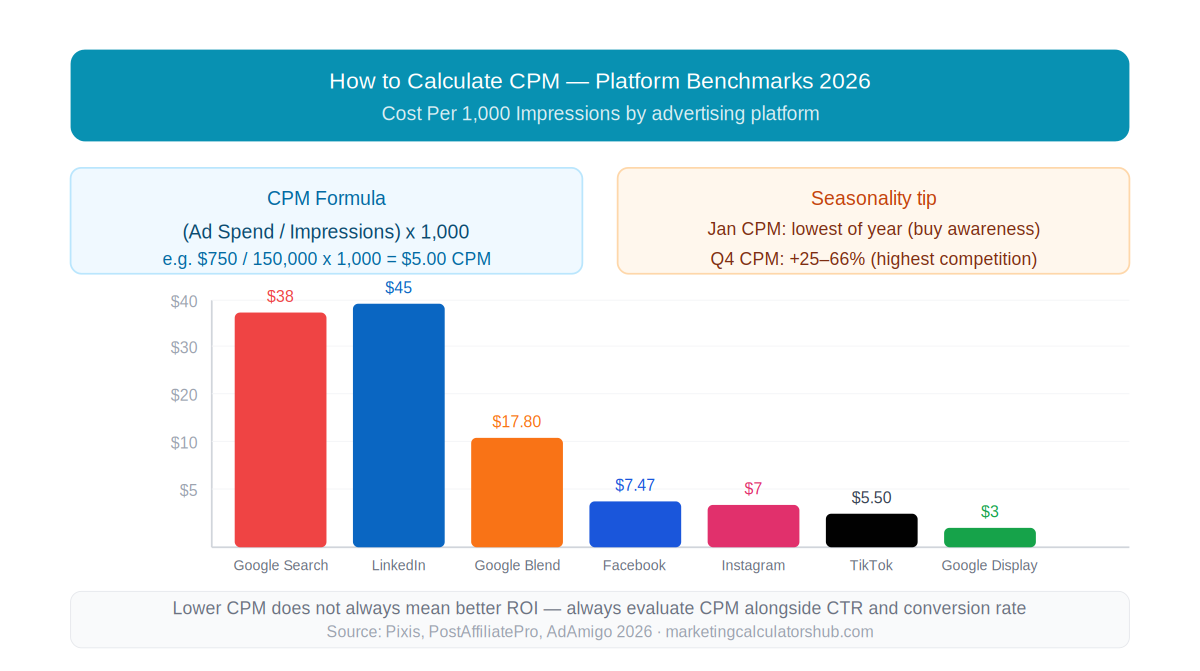
CPM is one of the most misunderstood metrics in digital advertising. Marketers obsess over getting a lower CPM — but a lower CPM doesn't always mean better results. This guide explains exactly how to calculate CPM, what good looks like on each platform in 2026, and how to use CPM intelligently alongside your other campaign metrics.
What Is CPM?
CPM stands for Cost Per Mille — "mille" being Latin for one thousand. It's the amount you pay for every 1,000 impressions your ad receives. CPM is the standard pricing model for display, video, and social media advertising where reach and visibility are the primary goal.
CPM tells you how efficiently you're buying audience attention — but not whether that attention converts into anything valuable.
The CPM Formula
Example: You spend $750 on a Facebook campaign and receive 150,000 impressions.
You paid $5 to reach every 1,000 people.
How to Calculate Total Spend from CPM
If you know your CPM and want to calculate how much a campaign will cost:
How to Calculate Impressions from Budget and CPM
If you have a budget and want to forecast your reach:
Example: $1,000 budget at a $7 CPM = 142,857 impressions.
CPM Benchmarks by Platform (2026)
CPM varies dramatically by platform, ad format, industry, and time of year. Here are the most current benchmarks:
| Platform | Average CPM | Notes |
|---|---|---|
| Google Search | ~$38 | Highest intent; premium pricing justified |
| Google Display | ~$3 | Low cost, low intent — best for awareness |
| Google (blended) | ~$17.80 | Search + Display + Shopping + PMAX combined |
| Facebook Ads | ~$7.47 | Lead gen campaigns: $25–$40 CPM |
| Instagram Ads | $6.25–$7.68 | Feed vs. Stories vs. Reels vary significantly |
| TikTok Ads | $3–$15 (avg $4–$7) | Most cost-efficient for awareness in 2026 |
| LinkedIn Ads | $30–$60+ | Expensive but unmatched B2B targeting |
| YouTube Video | ~$2–$5 | Strong reach at low cost; lower intent |
| Snapchat Ads | $3–$8 | Cost-effective for 13–34 demographic |
CPM Seasonality: When Is Advertising Cheapest?
CPM is not static — it fluctuates heavily based on advertiser demand throughout the year. Knowing when CPMs peak and trough lets you plan smarter budgets:
| Period | CPM Trend | Best Strategy |
|---|---|---|
| January | 📉 Lowest of year | Build awareness and audiences cheaply |
| Feb – Aug | ➡️ Stable | Consistent campaigns, predictable costs |
| Sep – Oct | 📈 Rising | Layer in conversion campaigns early |
| Nov – Dec | 🔥 Peak (+25–66%) | Highest revenue opportunity despite premium cost |
The global median CPM hit $25.22 in November 2025 — then dropped to $15.74 by January 2026. If you're running brand awareness campaigns, January through August offers the best bang for your budget.
CPM vs. CPC vs. CPA — Which Should You Use?
Choosing the right bidding model matters as much as your creative. Here's a simple framework:
- CPM — Use for awareness and reach. You pay for eyeballs regardless of clicks. Best for top-of-funnel brand building.
- CPC (Cost Per Click) — Use for driving traffic. You only pay when someone clicks. Best for mid-funnel campaigns targeting warm audiences.
- CPA (Cost Per Acquisition) — Use for conversions. You pay when a specific action happens (purchase, sign-up). Best for bottom-funnel campaigns with enough conversion volume for algorithms to learn.
Why a Low CPM Doesn't Mean a Good Campaign
This is the most important thing to understand about CPM. Here's a real example:
- Campaign A: $20 CPM, 2% CTR, 5% conversion rate → Cost per conversion: $200
- Campaign B: $5 CPM, 0.5% CTR, 2% conversion rate → Cost per conversion: $500
Campaign B has a 75% lower CPM but generates conversions at 2.5x the cost. Always trace CPM through to your actual cost per conversion before declaring a campaign efficient.
5 Ways to Lower Your CPM Without Hurting Performance
1. Broaden your audience. Narrow targeting drives up CPMs because more advertisers compete for the same small audience. Broadening targeting — especially using Meta's Advantage+ audiences — lets the algorithm find cheaper, high-quality placements.
2. Test cheaper placements. On Meta, Reels and Stories typically have 20–40% lower CPMs than Feed placements. On Google, Display has dramatically lower CPMs than Search. Test placements systematically before committing full budget.
3. Improve your creative quality score. Platforms reward engaging ads with lower CPMs. Higher click-through rates and engagement signals tell the algorithm your ad is relevant — which lowers your auction price. Fresh creative every 3–4 weeks prevents ad fatigue.
4. Advertise in Q1. January CPMs are the lowest of the year across all platforms. If your business allows, front-load awareness campaigns in Q1 and shift to conversion focus in Q2–Q3 when intent is higher.
5. Fix your pixel and conversion tracking. Inaccurate conversion tracking means the algorithm can't optimise properly — it serves your ads to cheaper but lower-quality audiences. A properly configured Meta Pixel or Google Tag Manager setup directly lowers CPMs by helping the algorithm find the right people.
Calculate Your CPM Now
Use our free YouTube CPM/RPM Calculator to calculate your effective CPM and RPM across your video campaigns. For broader ad campaign planning, our Google Ads Cost Calculator and Meta Ads Cost Calculator let you forecast impressions, clicks, and conversions from any budget.
Frequently Asked Questions
What is a good CPM for Facebook Ads?
A good Facebook CPM in 2026 is around $7–$10 for most industries. Lead generation campaigns typically run $25–$40 CPM. If your Facebook CPM is significantly above $15 for standard traffic campaigns, consider broadening your audience, refreshing your creative, or testing different placements like Reels or Stories where CPMs are typically lower.
What is a good CPM for Google Ads?
It depends on the network. Google Search averages ~$38 CPM — high, but justified by purchase intent. Google Display averages ~$3 CPM — low cost but lower intent. For blended campaigns across Search, Display, and PMAX, $15–$20 CPM is typical for well-managed accounts.
Why is my CPM so high?
The most common causes are: narrow audience targeting (too few people to bid for = higher prices), high-competition season (especially Q4), low ad relevance score (platform charges more for ads users don't engage with), or choosing premium placements like Facebook Feed over cheaper options like Reels or Stories.
What is eCPM and how is it different from CPM?
CPM is what advertisers pay per 1,000 impressions. eCPM (effective CPM) is what publishers earn per 1,000 page views from ads shown on their site. If you run Google AdSense on your website, your eCPM tells you how much you're earning per thousand visitors. The two metrics are related but calculated from opposite sides of the ad ecosystem.